Do Ho Suh’s Fabric Installations: A New Perspective on Home and Memory
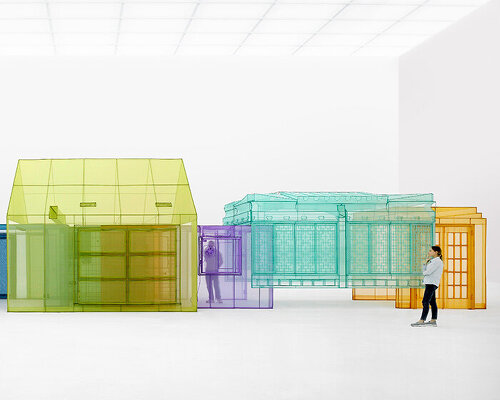
Do Ho Suh, a visionary artist, invites viewers to rethink the very essence of architecture through his captivating fabric houses. Utilizing translucent polyester meticulously stretched over delicate steel frames, Suh reconstructs spaces that evoke memories of his past homes, from Seoul to New York and London. His installations artfully blur the lines between memory and physical structure, transforming traditional notions of what a home can be.
In Suh’s world, door handles and light switches are not merely functional elements; they are integral pieces of a narrative that unfolds as visitors walk through these ethereal spaces. The walls, while appearing to delineate rooms, are soft enough to merge with the surrounding light, creating an atmosphere steeped in nostalgia. These installations challenge the viewer to confront their own memories, sparking recognition of familiar settings that may not be their own.
Historically, architecture has been synonymous with permanence, with structures designed to endure long after their occupants have moved on. However, Suh’s fabric houses defy this convention, emphasizing transience and adaptability. These installations can be easily folded and transported, suggesting that continuity—rather than permanence—may hold greater significance in our modern, mobile lives.
Renowned architect and theorist Gottfried Semper once posited that architecture’s roots lie in textile creation. Suh resurrects this idea, presenting buildings that function more like pliable skins than rigid frameworks. His art transforms architecture into an experience rather than a mere object, allowing walls to reveal interiors and boundaries to become permeable.
As viewers navigate through Suh’s installations, they encounter not just recollections of physical spaces but the ephemeral essence of their experiences. Philosopher Gaston Bachelard spoke of houses as repositories for memory, and Suh’s work embodies this sentiment. The details—like a worn staircase or the light through a particular window—are what linger in our minds, far more than the overall dimensions of a space.
In an increasingly globalized world, the concept of home has evolved. For Suh, home is no longer confined to a singular location; it exists across various landscapes and memories. His art reflects the realities of contemporary living, where individuals frequently transition between multiple cities and cultures. Corridors and doorways intertwine across continents, creating a tapestry of experiences that feels intimately familiar yet universally accessible.
Ultimately, Suh’s fabric houses symbolize a shift in how we understand habitation. They illustrate that home is not merely a static address but a dynamic collection of routines, relationships, and memories that accompany us throughout our lives. As society becomes more defined by movement than by the permanence of architecture, Suh reminds us that the essence of home lingers within us, manifesting in the gestures and memories we carry forward.
Source: www.designboom.com