3D Concrete Printing Sets New Trends in Argentine Construction
By Editor • August 12, 2026 • 3 min read
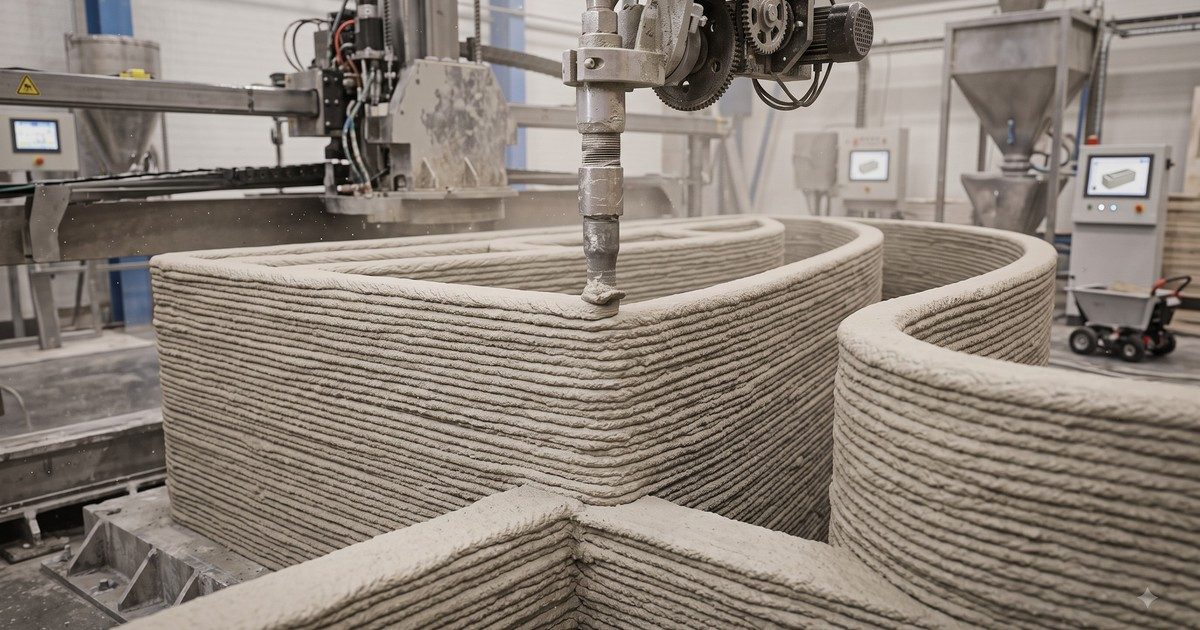
In a groundbreaking shift for the construction industry, the emergence of 3D concrete printing technology is transforming how homes are built in Argentina. Traditionally, constructing a house involved a labor-intensive process of laying bricks, mixing cement, and waiting days before progressing to the next phase. Now, however, 3D concrete printing (3DCP) offers a revolutionary solution that can erect a house in as little as 48 hours.
The technology, which has transitioned from laboratories to residential applications, utilizes large robotic arms to layer concrete according to a digital blueprint. This innovation has already been adopted in various countries for constructing homes, buildings, bridges, and commercial spaces, and it is beginning to gain traction in Argentina.
One of the key players in this local movement is Grondplek, a startup co-founded by tech entrepreneurs Mateo Salvatto, Pablo Viana, Tomas Chernoff, and Martín Mom. They have introduced a massive 3D printer from Danish company COBOD, which measures approximately 11 meters by 11 meters and stands 7 meters tall. The objective of Grondplek is to bring the advantages of additive manufacturing to construction, including automation, precision, reduced waste, and the ability to create complex geometries that would be costly or challenging with traditional methods.
Salvatto shared insights into the speed of this technology, noting that a 120-square-meter house can be printed in about 48 hours. However, it's important to clarify that this timeframe refers only to the printing process. A family cannot move in immediately after printing concludes, as additional work is necessary to complete the house, similar to conventional construction projects.
"The first reaction people have is disbelief — they ask, 'How can you build a house in 48 hours?' But the speed is indeed remarkable," Salvatto explained. The printer can produce nearly two cubic meters of concrete per hour. Therefore, if you run an 8-hour shift, you can finish the printing in just six shifts. This dramatically reduces the timeline from weeks or months to just days.
One of the most significant advantages of 3DCP is its ability to automate a process that typically requires numerous workers, materials, and steps. By using a digital file, the printer determines where and how much material to deposit, eliminating much of the inefficiency associated with traditional construction.
3D printers can execute a variety of designs with different materials. In the case of concrete printing, the process involves a special concrete mix that is formulated to be extruded through a nozzle mounted on a robotic arm. This approach begins with a 3D model created by architects and engineers, which is processed into layers that the printer will follow.
The printer primarily constructs what is known as the 'gray work'—the essential structure and walls of the building. Other aspects, such as installations, painting, and finishing touches, still require conventional methods and labor. While the printer operates with millimeter precision, some challenges may arise in design, mix preparation, or operation, but digitalization helps mitigate common errors and waste.
Salvatto estimates that this 3D printing system could achieve cost savings of around 30% compared to traditional building methods. These savings stem from reduced time, logistics, and waste, along with the potential to minimize the labor force needed specifically for the gray work.
However, this does not mean that 3D printing will replace construction workers. Salvatto emphasizes that 70% of the construction work remains traditional, requiring the same skilled tradespeople as before. "We don’t believe this will significantly reduce labor; rather, we aim to create better working conditions," he stated. The goal is to take on physically demanding tasks like repetitive material handling while maintaining jobs for skilled workers like plumbers and painters.
The homes constructed using this cutting-edge technology feature double walls with an air cavity, enhancing thermal and acoustic insulation. Additionally, the continuous structural integrity provided by 3D printing enhances seismic performance and allows for complex curves without incurring significant extra costs. Unlike traditional construction, where curved walls can drive up expenses, 3D printing simply requires programming a different path.
Source: www.clarin.com
#3D printing #Argentina #construction #innovation #technology