Mars' Underground Mystery: Scientists Uncover Thermal Anomaly
By Editor • August 26, 2026 • 2 min read
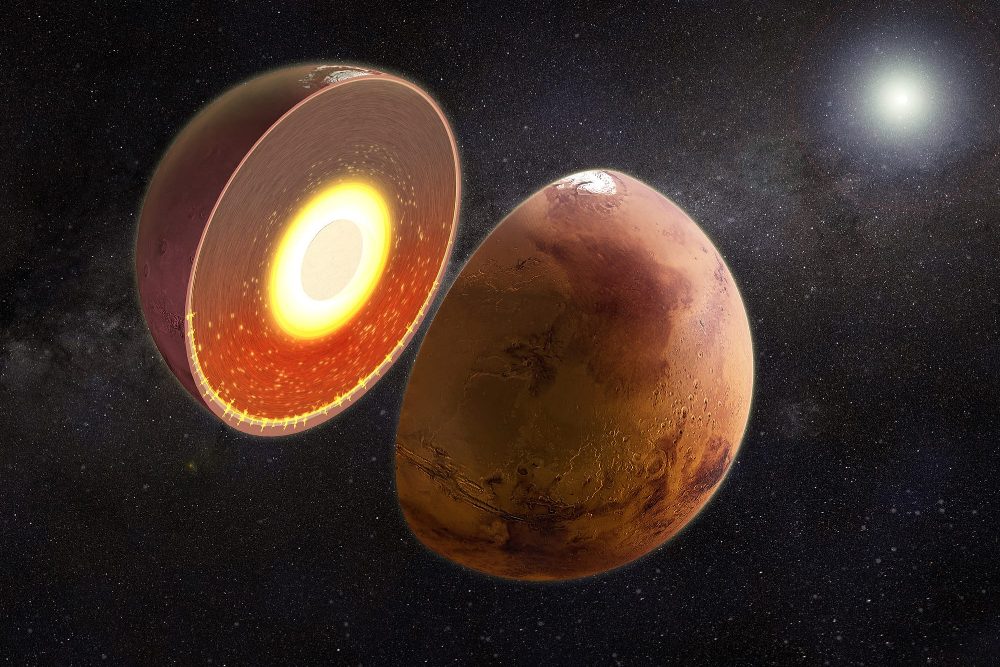
A groundbreaking study published in Nature has unveiled a significant thermal anomaly beneath the surface of Mars, which may offer insights into the planet's geological history and its potential to sustain life.
Using a unique method known as tidal tomography, researchers analyzed 16 years of data from three NASA orbiters—Mars Global Surveyor, Mars Odyssey, and Mars Reconnaissance Orbiter. This innovative approach allowed scientists to examine the gravitational fluctuations on Mars, revealing that the southern hemisphere's mantle is significantly warmer by 400 to 750°F compared to the northern hemisphere.
This stark temperature difference could hold the key to understanding the enduring puzzle of the Martian dichotomy—the stark contrast between Mars' northern lowlands, believed to have once hosted a massive ocean, and its southern highlands, characterized by rugged terrain. Nick Wagner, a planetary scientist at Brown University and co-author of the study, highlighted that while the findings don't provide definitive answers, they contribute valuable evidence to ongoing debates regarding Mars’ geological evolution.
Wagner pointed out that the findings suggest the crustal dichotomy may have roots in the planet's internal processes. He noted, “The origin of the dichotomy is still an ongoing question in Mars science, and a pretty fundamental one.” The study proposes that the thermal anomaly might stem from convection currents within the mantle or may indicate long-term insulation effects beneath the southern highlands.
Interestingly, the study does not rule out the possibility that ancient impacts may also have played a role in shaping Mars' surface. The researchers emphasize the need for further investigations to unravel the complexities of Mars' internal structure.
According to Wagner, the sharpness of the results was surprising but aligns with the understanding that Mars exhibits significant variations between its hemispheres. He remarked, “Mars seems to be dominated by these large scale variations from the north to south, so it makes sense that these variations also extend into the mantle.”
This research opens new avenues for exploring Mars' habitability, linking its geological dynamics to its ability to foster life. As NASA's Perseverance rover continues its quest in ancient lakebeds, scientists hope to piece together Mars' evolutionary story to better understand its past and the fundamental elements that govern habitability.
Source: www.404media.co