BEAR Architects Embrace Robert Smithson's Vision in Modern Design
By Editor • August 25, 2026 • 2 min read
In a striking exploration of forgotten landscapes, BEAR Architects are channeling the pioneering spirit of Robert Smithson, who famously sought beauty in the overlooked and mundane. Smithson’s iconic 1967 journey through Passaic, New Jersey, showcased how seemingly trivial urban elements could be reimagined as significant landmarks. Over fifty years later, BEAR is asking a provocative question: could the very spaces we ignore hold the key to understanding contemporary life?
Ane Arce and Iñigo Berasategui, the duo behind BEAR, reflect on their academic roots and the lasting impact of Smithson’s philosophy. They assert that landscapes are not static; rather, they are a tapestry woven from time and change. 'Every idea and every image we see of a landscape is composed of time,' they explain. BEAR emphasizes that architecture should not be viewed as a standalone entity, but as part of an ongoing dialogue with its surroundings.
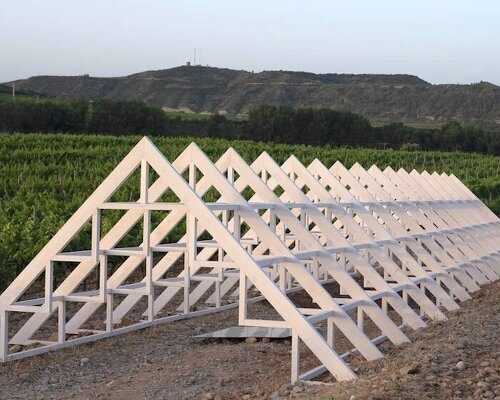
This concept materialized in their latest project, 'Temblores de superficie. Vino y Smithson,' at the Concéntrico 2026 festival in La Rioja, Spain. Faced with the vast expanse of a vineyard, BEAR opted to excavate rather than compete with the landscape, creating a 15-meter-long trench that exposes the earth’s layers beneath. This act of cutting into the ground not only reveals the soil and stones underneath but also highlights the region’s agricultural history.
Instead of erecting a conventional structure, BEAR's approach serves to illuminate the transformations already present in the landscape. The architects utilize materials and design elements that invite contemplation and interaction, echoing Smithson’s fascination with entropy and the passage of time. Their work urges us to recognize that architecture should annotate ongoing processes, rather than attempt to freeze them in time.
BEAR’s vision extends beyond the landscape into our homes. They express concern about traditional architectural expectations that demand spaces remain untouched despite the constant flux of human life. They argue that the kitchen, once a utilitarian space, is now the vibrant heart of the home, evolving to accommodate social gatherings and shared experiences.
In their designs, BEAR champions materials that tell stories and reflect the lives of their inhabitants. They favor natural materials that develop a “huella” or trace, as opposed to sterile, industrial finishes that resist change. A timber floor, for instance, can gain character over time through use, scratches, and exposure to light, ultimately becoming a testament to occupancy rather than a sign of deterioration.
For BEAR, Smithson’s idea of entropy transcends abandoned factories and ruins; it becomes a vital part of how we inhabit our homes and spaces. Their work reminds us that allowing architecture to embrace the passage of time could lead to a richer, more meaningful existence.
Source: www.designboom.com
#architecture #BEAR Architects #Concéntrico #entropy #landscape #Robert Smithson