Google Launches Advanced AI Weather Model to Enhance Forecast Accuracy
By Editor • September 3, 2026 • 2 min read
In a significant advancement for meteorology, Google DeepMind and Google Research have unveiled WeatherNext 3, a cutting-edge AI weather forecasting model that promises to deliver unprecedented accuracy and detail in weather predictions.
This latest iteration utilizes deep learning techniques to enhance our understanding of atmospheric behavior, a development that will be integrated into various Google products like Search, Google Maps, and Gemini. Samier Merchant, a senior staff engineer at Google, stated that this is the first instance where core variables will significantly influence many Google applications.
WeatherNext 3 has already shown remarkable performance in comparisons against other leading models, outperforming competitors from Microsoft, Nvidia, and the European Center for Medium-Range Weather Forecasting, as well as traditional forecasts from the US National Weather Service. The AI model excels in key metrics such as temperature, windspeed, and humidity, as evaluated on the Operational WeatherBench.
Unlike conventional forecasting systems that rely on costly government supercomputers to analyze complex mathematical equations, WeatherNext 3 leverages deep learning to produce quick and reliable weather predictions. Ferran Alet, a staff research scientist manager at DeepMind, emphasized that the chaos of weather patterns makes traditional methods challenging, and machine learning effectively addresses this by identifying patterns from vast amounts of data.
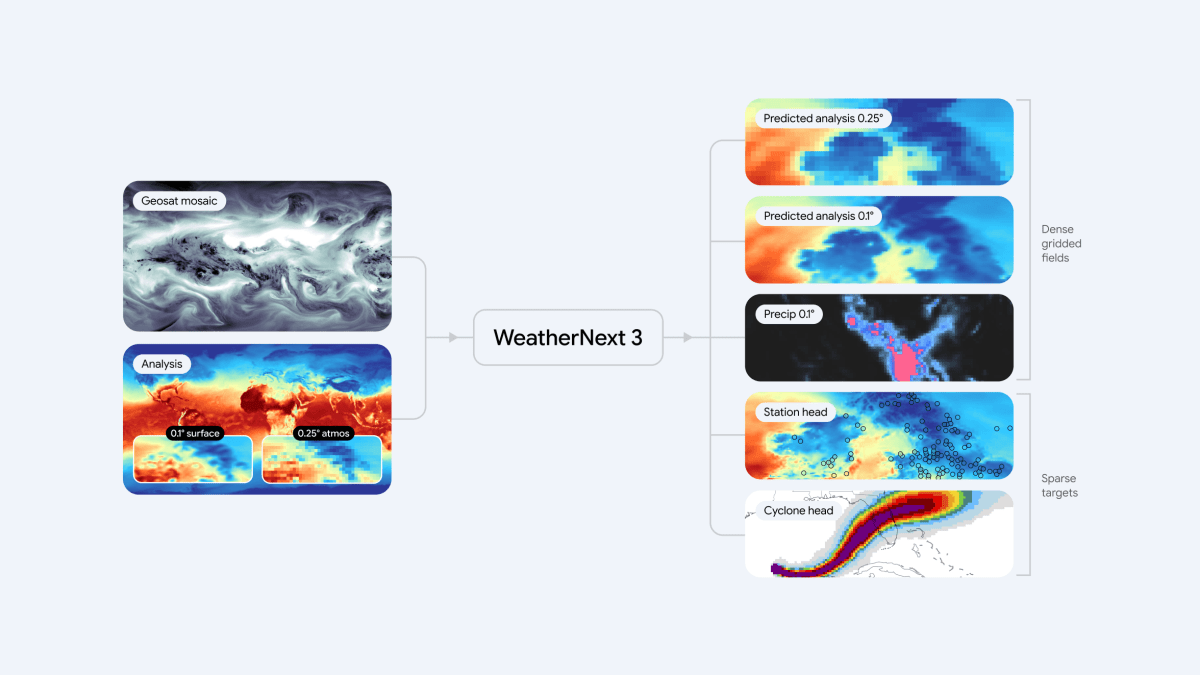
One of the standout features of WeatherNext 3 is its ability to generate forecasts at a remarkable resolution of 5 kilometers, significantly improving rain prediction accuracy by 60% over its predecessor, WeatherNext 2. Additionally, it can now provide hourly forecasts, enhancing the utility for users.
To achieve these improvements, the model's architecture has been expanded, boasting 2.4 times more parameters than before. The design choices made by the researchers allow for more precise targeting of forecasts to weather data stations, which not only enhances prediction granularity but also facilitates better validation against actual weather data.
WeatherNext 3 is also noteworthy for its capability to process real-time satellite data hourly, which aids in producing more accurate forecasts. Although Google claims to be the first to incorporate raw observations into a high-resolution global forecast, the AI weather startup WindBorne has been utilizing such data since late 2025, indicating a competitive landscape in AI weather forecasting.
As AI continues to revolutionize various fields, its application in weather forecasting is expected to provide significant benefits, particularly in developing regions where high-quality weather predictions are crucial for agriculture and renewable energy projects. Bill Gates has highlighted the technology's potential in enhancing crop yields in these areas, further underscoring the importance of accurate weather forecasts.
Source: techcrunch.com